Electrical, pneumatic and hydraulic schematic editor and simulator
Albert Schema Studio runs in your browser: no installation, no account. Place standard symbols, wire them, then simulate the circuit.
- More than 1,600 symbols (IEC 60617 for electrical, ISO 1219 for fluid power).
- Electrical control and power circuits: contactors, relays, timers, motor starters, programmable controllers (Grafcet and Ladder).
- Pneumatic and electro-pneumatic circuits: cylinders, 5/2 valves, limit switches and magnetic sensors, automatic A+ B+ A- B- cycles.
- Quantitative hydraulics: pressure (bar), flow (L/min), motor speed (rpm), cylinder force, relief and flow-control valves, Load Sensing.
- Guided exercises and a class mode for teachers.
- Export to SVG, PNG, PDF and DXF, bill of materials and wiring list. Works offline.
Open the editor: free, no account
The application interface is available in English: use the FR / EN switch in the top right corner.
Examples
- Motor starter (electrical) ★☆☆
Motor breaker, contactor, motor, latched start/stop and lamp. - Run / stop signalling (lamps) ★☆☆
Run lamp (NO contact) and stop lamp (NC contact) from the same contactor. - On-delay timer (electrical) ★☆☆
A lamp comes on 5 s after the timed coil is energised. - Motor starter with control transformer (electrical) ★★☆
Control circuit at 24 V AC through a single-phase transformer. - Delayed cascade start ★★☆
KM2 starts 5 s after KM1 thanks to an on-delay timer. - Relay at 24 V AC with terminal block ★★☆
Auxiliary relay KA1 at 24 V AC with terminal block X1: start/stop, lamps through NO and NC contacts. - Reversing starter (electrical) ★★★
Two directions, two swapped phases, KM1/KM2 electrical interlock. - Double-acting cylinder, manual valve (pneumatic) ★☆☆
Double-acting cylinder and manual 5/2 valve: hold the valve pressed in simulation. - Cylinder and solenoid valve (electro-pneumatic) ★★☆
Solenoid 5/2 valve driven by a switch; the A1+ limit switch lights a lamp. - Automatic A+ A- cycle (electro-pneumatic) ★★★
Automatic A+ A- cycle: bistable valve and two limit switches. - A+ B+ A- B- cycle with a programmable controller (Grafcet) ★★★
A+ B+ A- B- cycle: two cylinders 1A and 2A, bistable valves 1V1 / 2V1 (coils 1YV14, 1YV12, 2YV14, 2YV12), position sensors a0 a1 b0 b1 and a PLC programmed in Grafcet. - Hydraulic bench: motor and meter-in flow valves ★★☆
Hydraulic bench: 18 cm³ motor-pump unit at 1500 rpm, relief valve at 100 bar, closed-centre 4/3 valve, one-way flow valves and a 100 cm³ hydraulic motor. Hold the click on a valve solenoid, set the flow valve opening and the motor load, read pressures and speed. - Hydraulic bench: cylinder and meter-out flow valves ★★★
Hydraulic bench: 50/30 cylinder, 350 stroke, with meter-out flow valves. Observe the pressure intensification on the rod side during extension and the cylinder speed as a function of the valve opening. - Hydraulics lab 5: secondary relief valves ★★★
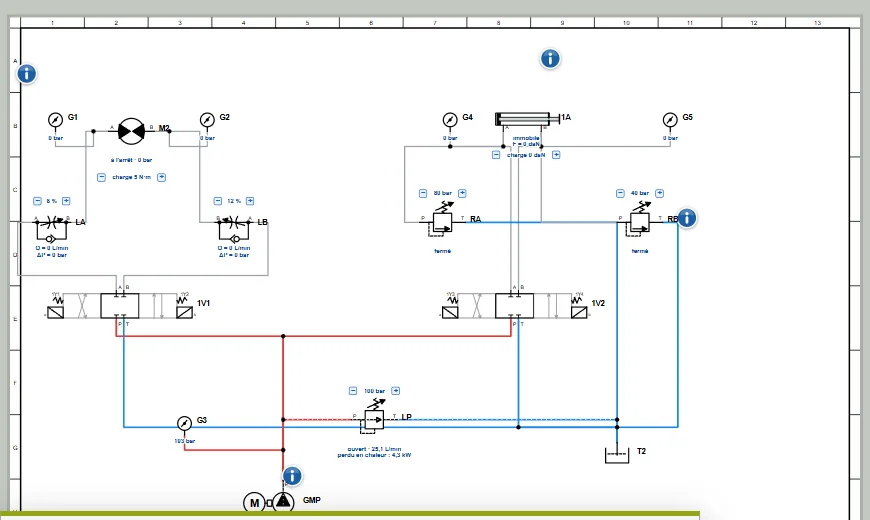
Bench lab 5: motor (flow valves) and cylinder in parallel, a secondary relief valve on each cylinder line (80 bar cap side, 40 bar rod side) under the 100 bar main relief. Stall the cylinder then run the motor: pressure drops to the secondary setting and the motor slows down. - Hydraulics lab 6: pressure reducing valve ★★★
Bench lab 6: a pressure reducing valve set to 50 bar feeds the cylinder while the motor keeps the circuit pressure (100 bar). At the stop, cylinder pressure stays at 50 bar. - Hydraulics lab 7: pilot-operated check valves ★★★
Bench lab 7: two cross-piloted check valves (each is piloted from the other line) hold the cylinder at the valve centre; they release only when the other line is pressurised. - Hydraulics lab 8: constant-pressure pump ★★★
Bench lab 8: variable-displacement pump regulated at 100 bar, safety relief at 120 bar. The pump adjusts its flow to what the flow valves let through to the motor; compare with the fixed pump of lab 1 where the surplus goes to tank. - Hydraulics lab 9: Load Sensing ★★★
Bench lab 9: Load Sensing pump. A shuttle valve picks the higher pressure of the two motor lines and the pump holds 15 bar more. Vary the motor load: pump pressure follows and speed stays constant.